Working Philosophy
I believe technology leadership is about turning uncertainty into clear decisions, ambitious ideas into dependable systems, and capable individuals into teams that deliver meaningful outcomes.
My approach has been shaped by more than 25 years of building products, platforms and engineering organisations, as well as by my education in engineering and the principles of Agile, Lean and Software Craftsmanship. Across different roles and environments, I have learned that good technology work requires more than technical competence: it requires clarity of purpose, sound judgement, disciplined execution and the willingness to keep learning.
Whether I am shaping technology strategy, designing an architecture, building software, leading an engineering organisation or advising a client, the following principles guide how I work.
The Principles That Guide My Work
Start with Outcomes and Purpose
Technology should solve a meaningful problem, enable a valuable product or strengthen an organisation’s ability to deliver. I begin by clarifying the outcome, the users or stakeholders affected, and the constraints that matter before committing to solutions.
Make Decisions Transparent
Architecture and technology decisions should be understandable, reviewable and open to improvement. I document assumptions, trade-offs and reasoning so that teams can challenge decisions constructively and evolve systems with confidence.
Build Quality into Delivery
Quality is not a final inspection step. It is created through clear design, automated testing, secure engineering practices, observability, continuous integration and disciplined delivery processes that make change safer and faster.
Prefer Short Feedback Loops
I favour small increments, early validation and frequent feedback over long periods of assumption-driven work. This applies equally to product development, architecture, engineering delivery and organisational change.
Enable Teams to Take Ownership
Strong delivery depends on teams that understand their purpose, own meaningful outcomes and have the technical and organisational support required to succeed. Leadership should provide direction and clarity while creating space for responsibility and professional growth.
Adapt Practices to Context
Principles matter; dogma does not. Agile, Lean, Domain-Driven Design, Continuous Delivery and Software Craftsmanship are valuable because of the outcomes they enable, not because they should be applied mechanically in every situation.
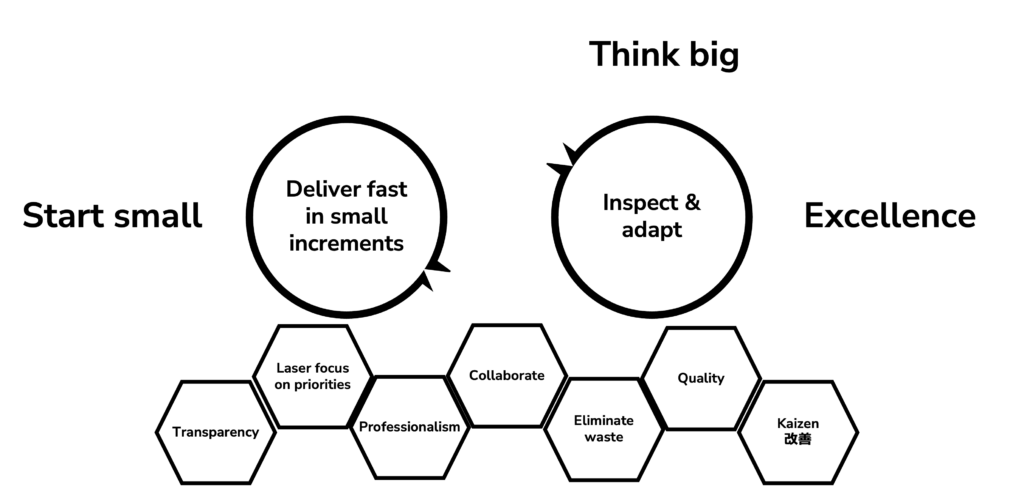
My Principles at a Glance
The following visuals summarise the values and practices that influence my approach to technology leadership, architecture and software delivery.
What This Means in Practice
Shaping Strategy and Architecture
When shaping a product or platform, I work iteratively from purpose and business context towards an architecture that can support delivery and change. I involve relevant stakeholders early, identify key constraints and risks, and make important technical decisions visible through documented assumptions and trade-offs.
Architecture is not a static presentation produced at the beginning of a programme. I treat it as a living body of knowledge that evolves alongside the product, supports collaboration and helps teams make consistent decisions over time.
Building Products and Platforms
When building software, I favour small increments, rapid feedback and reliable automation. Practices such as automated testing, continuous integration, secure delivery pipelines, observability and continuous refactoring allow teams to change systems safely while keeping pace with evolving product needs.
For AI-enabled and cloud-native systems, this also means treating security, evaluation, operational visibility and production reliability as essential capabilities rather than later additions.
Leading Engineering Organisations
When leading teams, I aim to create clarity around purpose, priorities, ownership and technical direction. I believe teams perform best when they understand the outcomes they are working towards, can influence how they achieve them and receive timely feedback on both delivery and impact.
My role as a leader is to remove ambiguity where it blocks progress, establish sound engineering and delivery conditions, develop people and encourage honest dialogue about risks, trade-offs and opportunities for improvement.
Advising Organisations Through Change
When advising an organisation, I first seek to understand its context: its goals, existing capabilities, constraints, risks and readiness for change. Recommendations must be technically credible, commercially sensible and realistic for the people expected to implement them.
I therefore focus on practical improvements that can be adopted, measured and refined rather than on abstract target states disconnected from day-to-day delivery.
Demonstrated Through Real Work
These principles are not only aspirational. They have shaped how I have built products, led teams and delivered technology outcomes across startups, enterprises and mission-driven organisations.
- From idea to operational AI platform: For Major Tom, I joined at product inception and helped take an agentic DevOps platform from concept to a customer-connected MVP within five months, combining secure cloud architecture, AI capabilities, automated delivery and production observability.
- Technology designed for meaningful social impact: As Co-Founder and CTO of Tabiya, I helped build open-source AI and labour-market infrastructure whose inclusive skills taxonomy was deployed through SAYouth.mobi, a platform serving more than 3.8 million young people in South Africa.
- Delivery transformation in a complex environment: At Capgemini, I helped rebuild the engineering capability for a mission-critical national digital-platform programme, establishing a new cross-functional delivery organisation and moving integration cadence from releases every two months to multiple integrations per day.
- Product development sustained through growth and acquisition: I co-founded the venture behind the BONAPART process-management product line, built an international engineering capability and led product development through acquisition and subsequent integration into BTC AG.
Strong Principles, Applied Pragmatically
I value principles because they support better decisions and better outcomes. At the same time, every organisation, team and product has its own context. A practice that works well in one environment may need to be adapted, simplified or replaced in another.
My philosophy is therefore firm in purpose but flexible in application: remain focused on value, make decisions transparent, build quality into delivery, learn quickly and treat constructive challenge as an opportunity to improve.
This is the mindset I bring to technology leadership, architecture, product development and advisory engagements.
Facing a Significant Technology Challenge?
I work with organisations that need experienced technology leadership, sound architecture and practical execution to move an important product or platform forward.